

To kick off this year’s Baseline Shift sessions we welcomed Kate Dawkins, founder of Kate Dawkins Studio, who shared her fascinating experiences with projection design, speaking about her journey as a graphic design student into her role now.
A designer’s journey
Growing up in a deeply creative household with a father who built furniture and a mother who had a ‘dab hand at making beanbag frogs’, Kate was always drawn to creative fields, in particular the arts, wanting to become a famous ballet dancer. From Helvetica curtains, to drawing with a spirograph, Kate from a young age was curious about patterns, formations and colour. Starting out as a graphic design student, her world then was full of typography, grids and composition, with a strong focus on ‘clarity, order and storytelling on a page’. Her degree was very much about learning the rules about graphic design. She then went on to undertake a master’s degree at Central St Martin’s in visual communication which was an exciting time for creative expression and pushing the boundaries, particularly regarding music and emerging technologies.
‘Curiosity pulled me forward’; there was a real question on what happens when design moves and this is where she began to look at the role of the viewer. This curiosity took Kate into the realm of moving graphics in the form of title sequences, broadcast graphics, commercials and music videos. This is where she would create club visuals for ‘Sound of the Asian underground’ and, more notably, where she would be scouted by American photographer David LaChappelle on her take for Elton John’s ‘Are you ready for love’, finding herself working on a massive live production creating the pop art visuals for Elton John’s Las Vegas show in 2004.
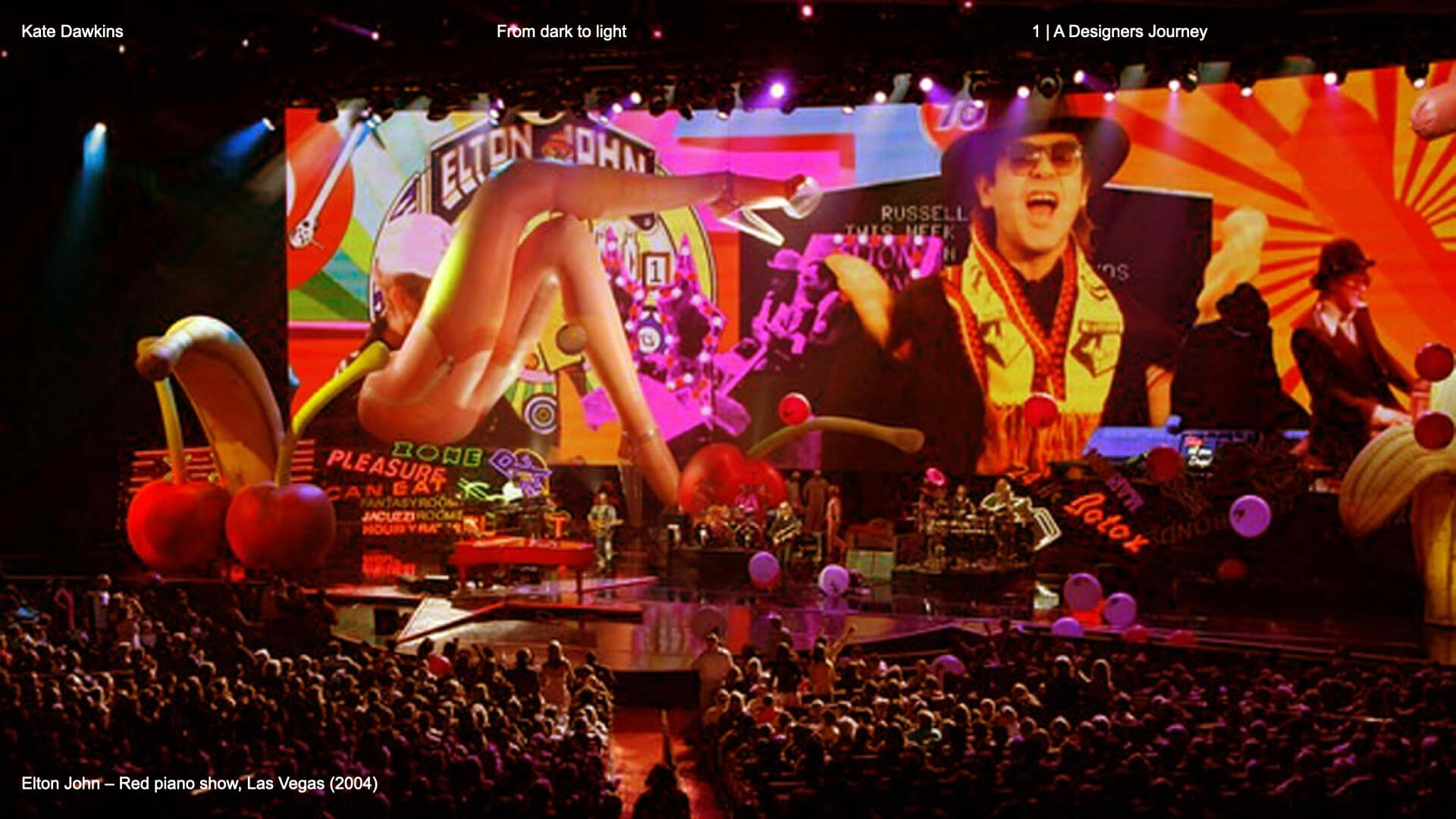
Designing for live events
Kate proposed factors to consider when designing for live audiences. She expressed you could be designing for 80,000 people in a stadium or one at home sat watching tv, acknowledging people experience live events in different ways; but how do you reach them all? She highlighted 3 key components, the first being instant impact, which is all about creating bold visuals anyone can grasp in seconds. The second was emotional resonance, what emotions do you want to evoke from the audience in that moment? And the last was deeper meaning, looking at symbolism and detail that lingers afterwards. An example of this was her project for remembering WWI Passchendaele. This was the first building projection Kate undertook for the commemoration of the 100 years since the Battle of Passchendaele. Here they created a giant typographic poem by Siegfried Sassoon projected onto the building, breaking up into layers to hit these three components of design.
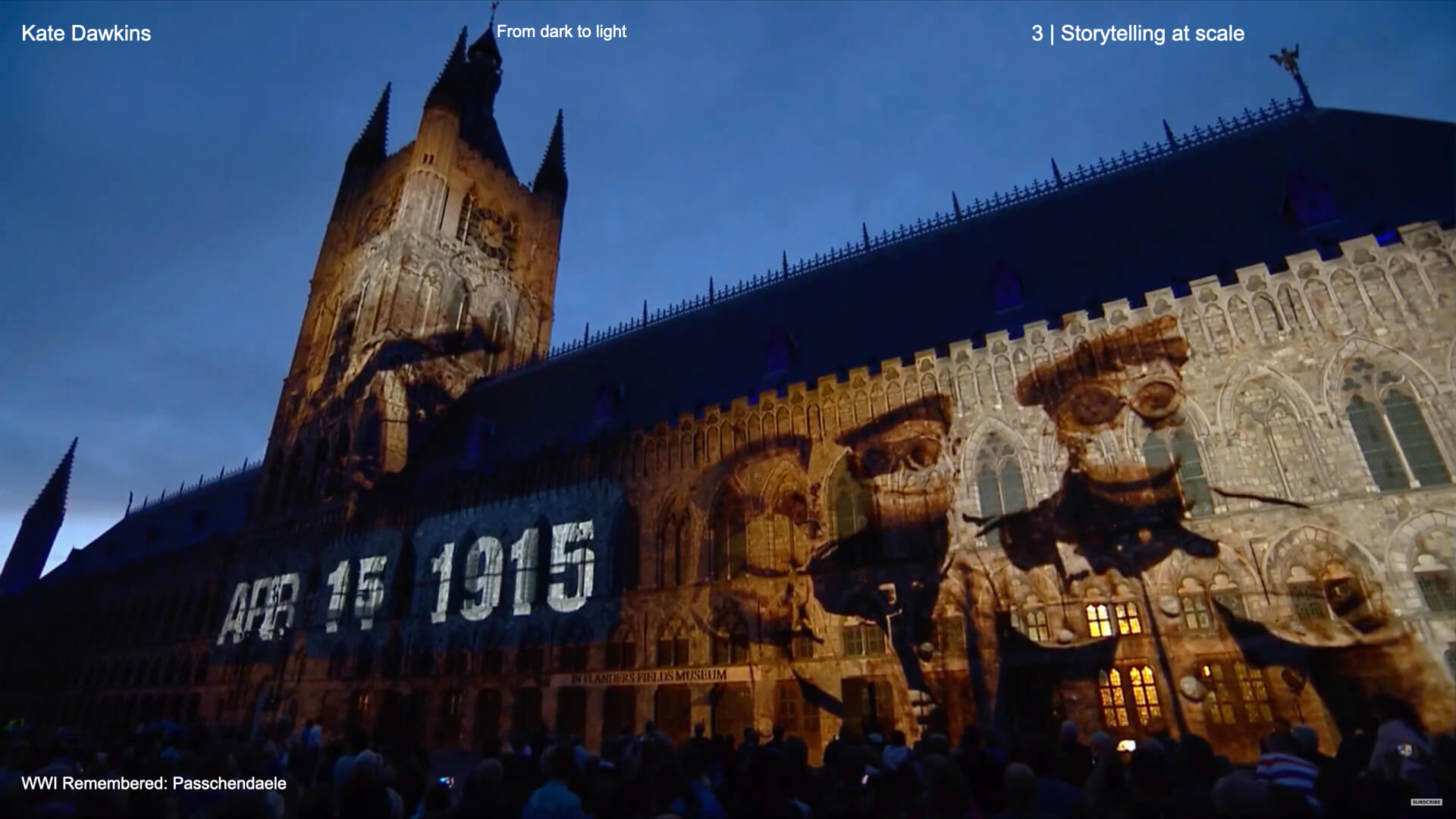
Storytelling at scale
‘At scale storytelling is what carries you from first sketch to the live show’. Kate begins with research and listening to the client, as well as gaining context for the project, the background and history. Moving on to expressing this visually, Kate looks at concepts and storyboarding, crucially through initial sketches. The next stage looks at rehearsal and refinement – depending on how technology is acting up on the day requires the need for onsite technical changes right up to delivery. Something impactful Kate mentioned was ‘One chance, no do overs’ – even reading this quote gives that sense of adrenaline rush when you have one chance to get it right on the day!
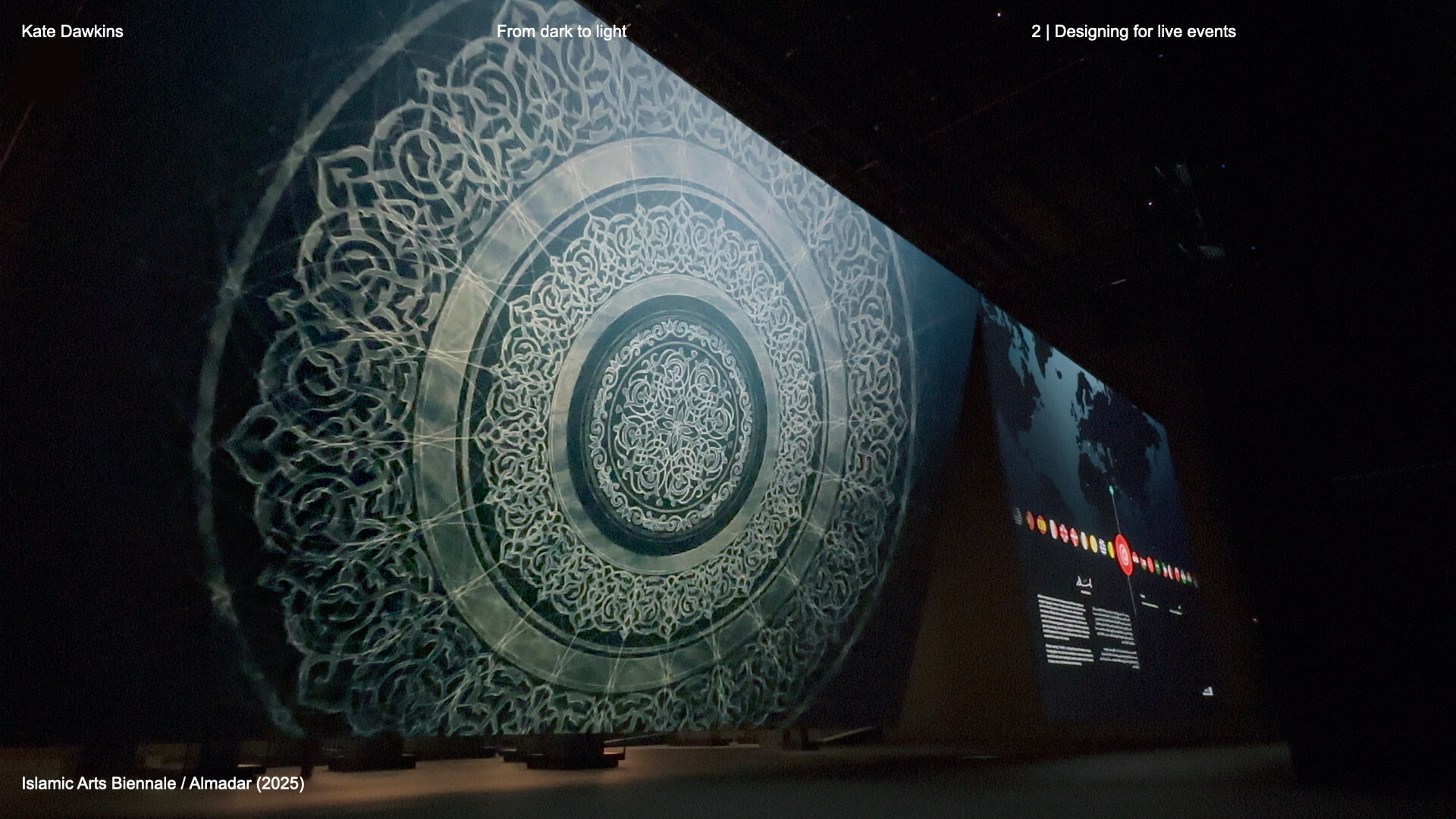
A glance at a case study
One of the many inspiring case studies Kate walked us through was her involvement in the ‘Islamic Arts Biennale’. Here Kate mentions it’s not only the audience you’re designing for in the seat, but the cultural and architectural impact of a space. Starting with a complete blank canvas, an old airport terminal, Kate worked together with architects to design the space. The task was to ‘create an abstract introductory film that set the emotional tone – communicating both the heavenly and earthly aspects of the exhibition’. This was combined with studying and portraying centuries worth of history through the artifacts, looking at how to portray their identity through materials and textures. This translated into a piece of moving images, achieving an exhibition that felt ‘contemporary and timeless’, as well as encompassing the emotional journey of the audience.
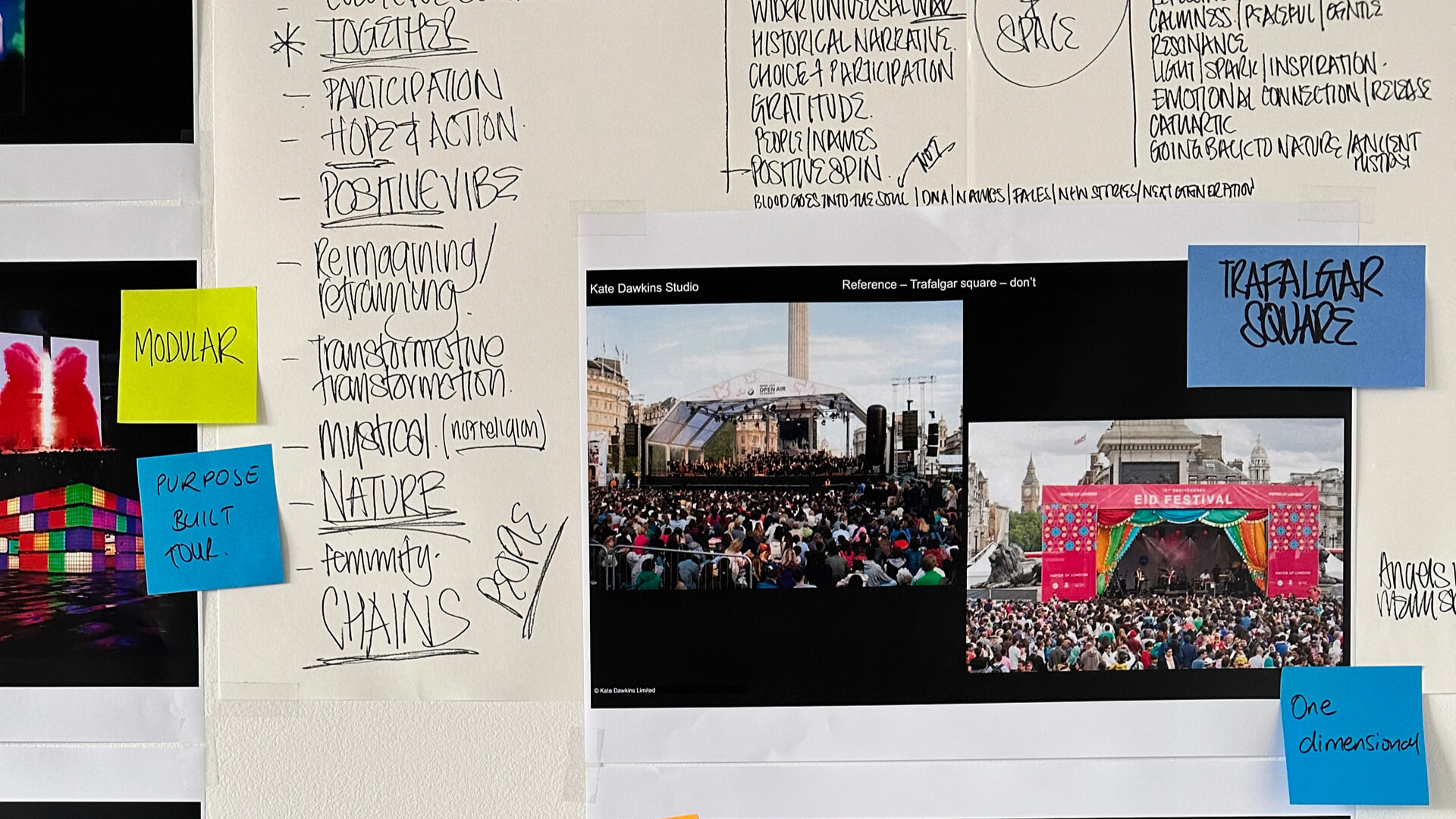
The power of people
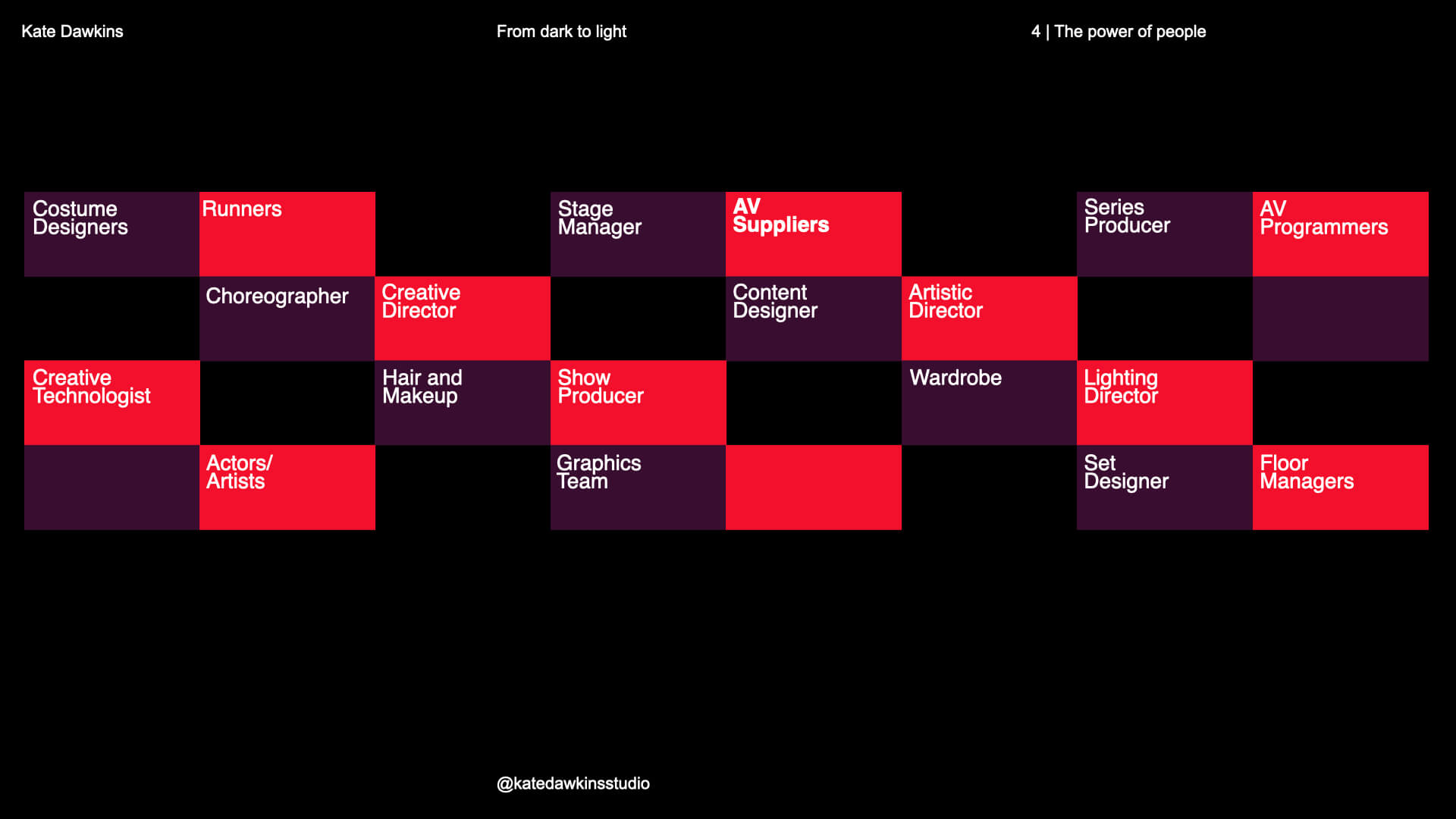
Collaboration is something Kate valued to be most important when it comes to any project. Although her team in the studio is made up of only two people, it takes a lot to get a live production up and running, requiring involvement from producers, editors, runners, choreographers etc. Kate expresses the role of design here is to ‘lead, listen and bring clarity out of complexity’ because live events cannot be conducted alone.
Technology with purpose
Technology serves a crucial purpose, with tools being an important part of the process.
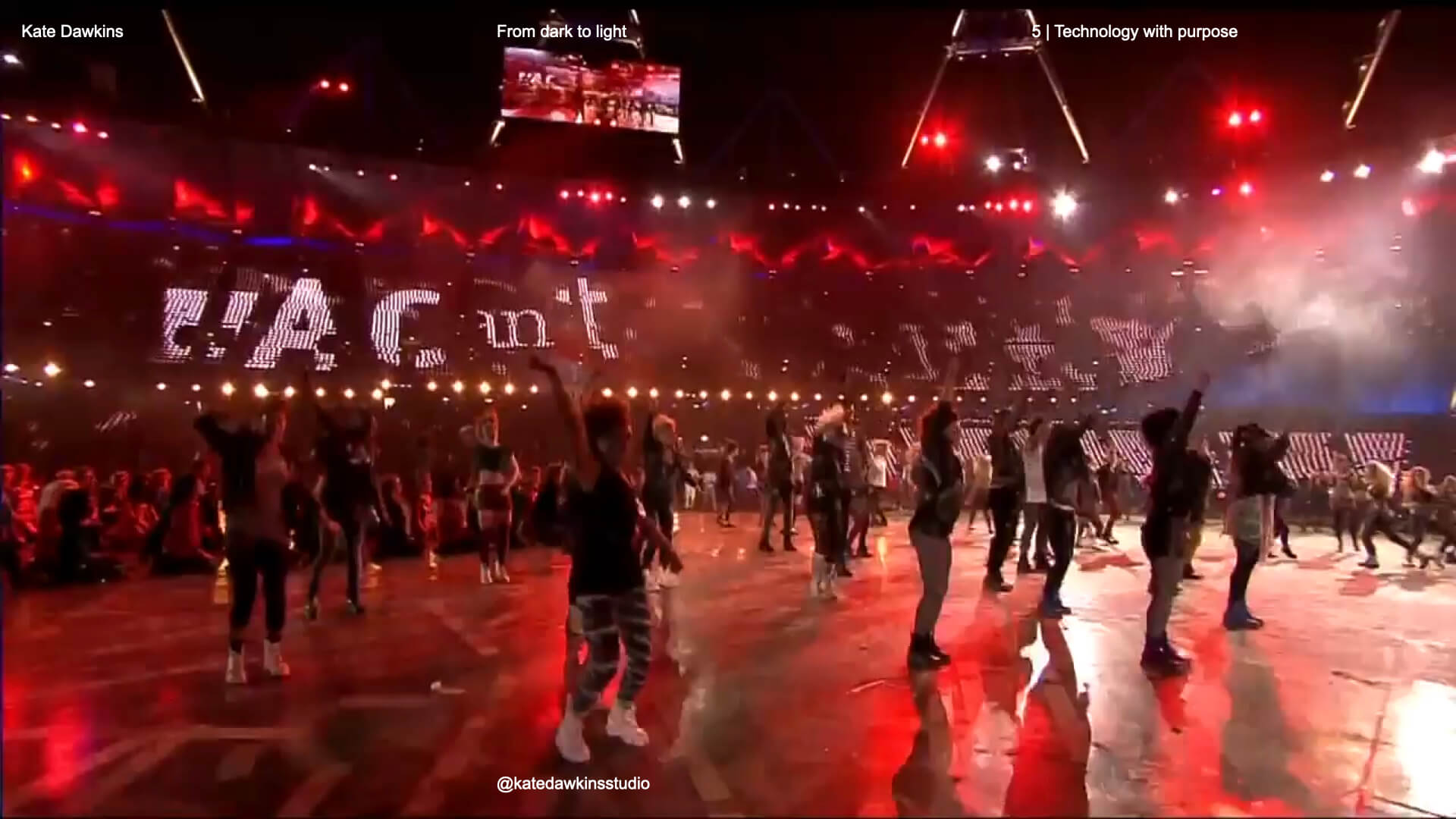
The beginning of Kate’s career used predominantly analogue techniques, with even the Elton John music video being created in this way. Kate mentions computers can feel quite soulless and highlights the need to keep tactile elements – she ensures that there are always materials to experiment with that can be found around her studio. Kate used this in a live event for the 2012 Olympics, where she tore up fanzines and abandoned digital outputs for a Sex Pistols piece. Something that resonated with students was ‘We go to a lot of effort to make things that most people won’t even see, but I’ll know and that’s important’
Thank you, Kate, for an inspiring talk into this world of live event design!
Advice for young designers
- Start small, think big
- Learn to love the dark – lean into enjoying what the project could be
- Build skills across disciplines
- Collaboration is everything, best work happens together
- Design for emotion, not just aesthetics
- Protect your curiosity
– Written by Amirah Yasin
– Edited by Tommy Molnar